Even if some of us might not consciously cultivate a trauma-sensitive teaching practice, I honestly believe that most of us educators hold a “first do no harm” philosophy; none of us wants to intentionally or unintentionally cause hurt or pain in our students. Units on the family, however, force us to think about the potential harm we might inflict on our young charges. While both U.S. and Italian societies hold up the traditional model of the nuclear family as the norm in our societies, it has never been true, historically, that every student hails from this “norm.” My own mother, born in a small town in the Romagna region of Italy at the cusp of World War II in 1939, never knew her father who was lost at the evacuation of Tripoli (Libya), and whose name my grandmother never put on my mother’s birth certificate. 7 years later my mother had a sister, from a different father, a Polish soldier stationed in my mother’s hometown who never married my grandmother. Single parent households, children raised by close or distant relatives (or even strangers), and adoption are not a new phenomenon. We do not need to know every student’s story or trauma in order to make sure we do not retraumatize or stigmatize them. What we do need to do is reimagine how we present and have students work with family-related vocabulary and concepts.
Chi sono io? (Who am I?) or Chi sei tu? (Who are you?): Centering how students choose to identify themselves in the context of a family
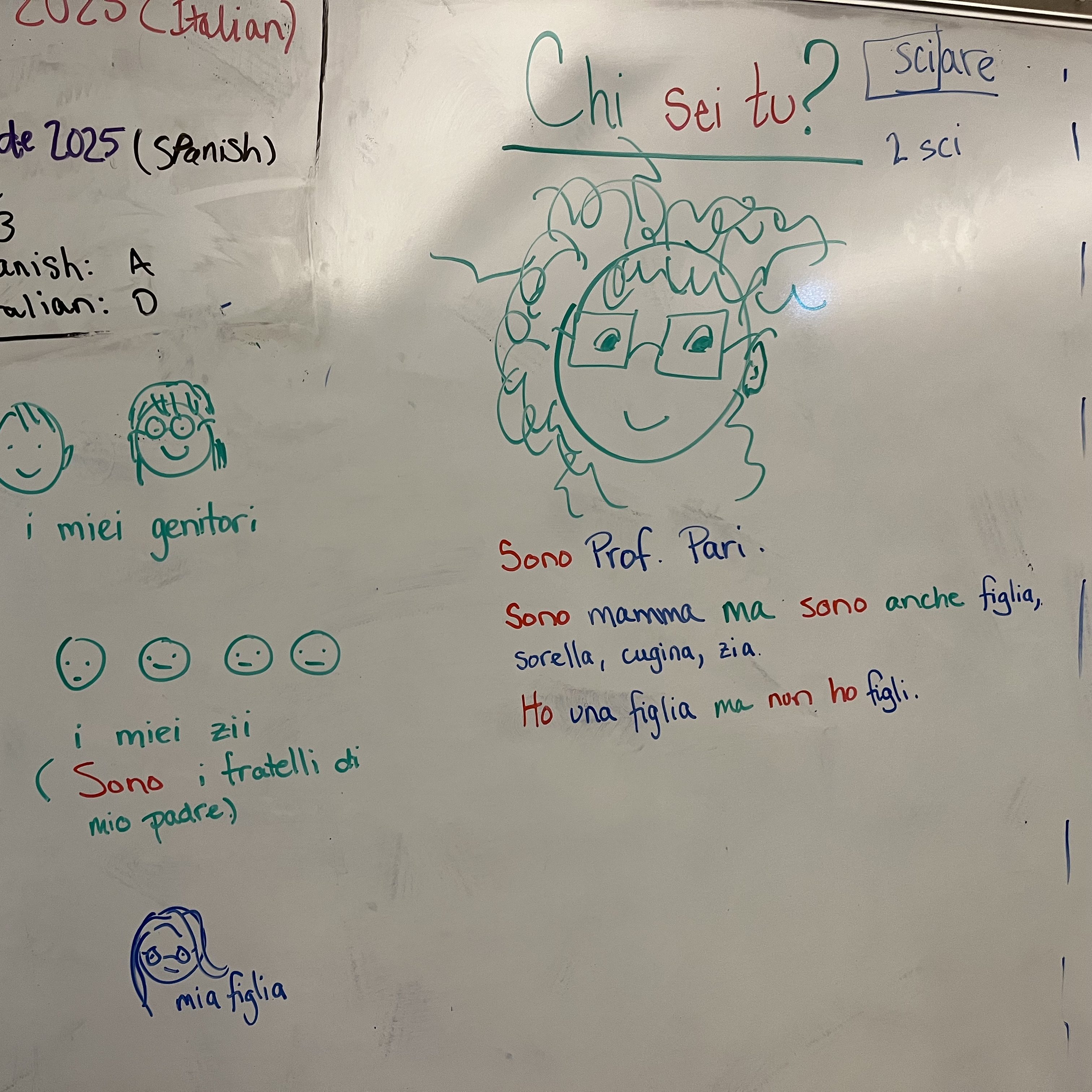
I am currently in the process of teaching this unit. Before even learning about trauma sensitive curricula or classrooms, I decided that the traditional family tree project was, at best, potentially stigmatizing. I have reimagined the family tree project by inviting students to draw a visual representation of themselves in the middle of a page, and to answer the question Chi sono io? or Chi sei tu? using the family-related vocabulary list I provide. (And, yes, the first family-related vocabulary list that I provide them is still generally one of immediate family relationships that can seem to center the stereotypical nuclear family.) On the classroom whiteboard, or on a Google Slide or in the Smartboard software, I draw a bad visual representation of myself, and, underneath it, write my example, for my own life: Sono Prof. Pari. Sono mamma ma sono anche figlia, sorella, cugina, zia. Ho una figlia ma non ho figli. Then, I invite students to look at their statements, and, based on what they wrote, to draw a visual representation of each of the people with whom they share a family relationship. They then must also label each of these people with the Italian word for their relationship. In my case, I drew a representation of my parents and labeled it i miei genitori. Based on a previous written text about my family that I had given my students to read, as an introduction to this new unit and vocabulary, I also drew a visual representation of my father’s four brothers and labeled it i miei zii. For clarification, and to help students expand their own writing, I added Sono i fratelli di mio padre. This is to preview the third person grammatical form of the verb essere (we have only formally used the io and tu forms so far). By centering their own identity and how they view and label themselves, this allows students to control their output, their sharing, to decide for themselves which relationships are important to their life, as well as, of course, to learn and use important vocabulary which is a part of the fabric of both U.S. and Italian society.
Celebrity or TV Show Family Tree
Over the past 20 years of my career, I have learned other inclusive alternatives to the ubiquitous family tree project from my world language colleagues. Several of them have combined interpretive reading or listening assignments about celebrities in the cultures they teach or about TV show families, of either U.S. TV shows or TV shows from the cultures they teach that they also show in the classroom. You can use this twist of using U.S. TV shows or even movies that feature families when you teach media in higher language level course by asking students to describe the relationships in the target language when they write a review of their favorite TV show or movie (or a review of an assigned movie, such as the animated Luca or the Italian tie-in to the ELA Anne Frank unit or the social studies unit on World War II, La vita è bella).
Birth Certificates and Background Stories for Plushies or Dolls
Another fun inclusive activity for learning family-related vocabulary, while integrating an interpretive reading assignment, is to have students read some authentic Italian birth certificates (which you can find examples of online), and then create birth certificates for their favorite plushies or dolls (you would ask them to bring them to school from home) or for plushies or dolls that you provide (Dollar Tree is a great place to find some good ones). They could also create back stories for the plushies, all while learning and using the family-related vocabulary. The students could work in pairs on the birth certificates and then in triads or quads for creating family relationships amongst the various classroom plushies/dolls.
Remember Your Goal: Learning and Using Target Language Vocabulary
In the end, it pays to remember the goal of this unit. Perhaps it is to explore and discuss the Essential Question of What is a family? But even so, the ultimate goal is for students to learn the target language vocabulary through purposeful, meaningful use. It does not have to be about their own family unit, which can be traumatizing or stigmatizing to some students, either to be meaningful or to accomplish this goal. It does have to reach and teach all students, regardless of their own family situation. I hope you will try some of these in your classroom and share them with your colleagues, not only in world languages but also in other core curriculum courses – and please share the outcomes! Do you have your own inclusive alternatives to the standard family tree project? Please share that, too!
 Project-Based Italian