Image by Clker-Free-Vector-Images from Pixabay
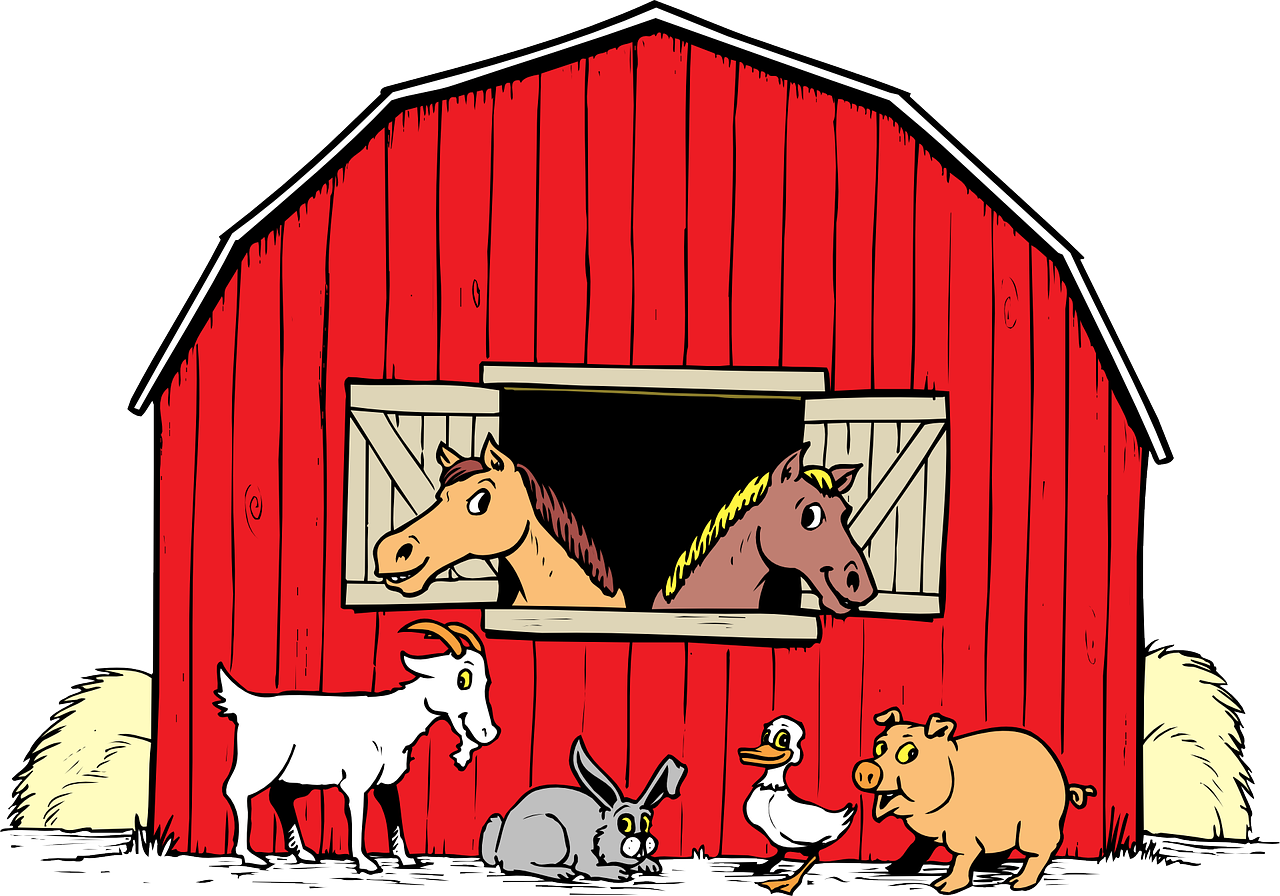
This post all about onomatopoeia in Italian; the sounds animals make, for example, are not the same in Italian and English, though sometimes the sound is the same but the spelling uses Italian phonetics. Be prepared, though, for students to make these sounds in class – loudly!
Cani e gatti (Cats and Dogs)
While dogs in English say arf, woof or bow wow, in Italian dogs say bau bau (remember to use the verb fare to mean “says”: Il cane fa bau bau). For older kids, we can teach the name of the action as well as how it is conjugated, at least in the present tense: abbaiare (to bark) – Il cane abbaia. (The dog barks.) This is also a great opportunity to teach, reteach, or reinforce Italian phonetics (in this word the Italian i is actually a glide, like the English y), syllabification (ab-ba-ia), stress patterns (natural stress pattern in Italian is on the next to last syllable so: ab-ba-ia).
To teach, re-teach, or reinforce the sounds of the Italian i, we can show the spelling of the sound cats make: meow in English becomes miao in Italian (unlike ciao, where the i functions to soften the c to create the English ch sound). Syllabification or, as I like to remind my students, the fact that Italian tends to pronounce every letter separately (in contrast to English diphthongs), for miao is mi-a-o. The action of meowing in Italian is miagolare: Il gatto miagola (mi-a-go-la, an exception to the natural Italian stress pattern). As we know, cats also purr or make a vibration that, in Italian, sounds like prrr-frrr when they are happy. In Italian we use a verb phrase with the irregular verb fare, fare le fusa: Il gatto fa le fusa. Be careful though! There is another Italian verb that means to hum or vibrate, ronzare, but Italian cats do not do this, mosquitoes ronzano: Le zanzare ronzano!
Grilli (Crickets)
I have a hard time understanding the modern expression “Crickets!” when a statement or a speech meets with silence from an interlocutor or an audience. I mean, on a calm, quiet summer night in the country, the crickets are pretty loud, in my opinion! In English crickets chirrup or chirp, whereas in Italian the verb is frinire, which is conjugated with an -isc- in the present tense, like finire or capire: Il grillo frinisce. For little kids, we describe the chirping sound as cri cri or fri fri, and use the verb fare (to do or to make): Il grillo fa cri cri. Il grillo fa fri fri.
Galline, galli, pulcini ed altri uccellini (Hens, Roosters, Baby Chicks and Other Baby Birds)
In English, roosters crow and hens (or chickens) cluck. A rooster’s English crowing is usually represented as “cock-a-doodle-do!” In Italian, roosters sing, cantare, chicchirichì, while hens (or chickens) say coccodè – Il gallo canta. Il gallo fa chicchirichì mentre la gallina fa coccodè. This is a great opportunity to teach, re-teach, or review and to have students practice stressing the accented last vowel orally.
Baby chicks cheep or chirp in English but in Italian they pigolare, though honestly I do not know a single city-dwelling native speaker of Italian that has actually heard of this verb; I know my Florentine and Turin cousins, at least, had know idea what it meant when I asked them! At any rate, Italian toddlers are introduced to the sound baby chicks make with pio pio: I pulcini fanno pio pio nell’aia. I pulcini pigolano mentre cercano la mamma.
On the other hand, other baby Italian birds do go cheep, but spelled, of course, with Italian phonetics: cip cip. This action is called cinguettare and, again, it is a good reminder to students to pronounce every letter separately, including the u and each of the double ts, not to mention a reminder that ci is pronounced like the English ch combination.
Altri animali nell’aia (Other Barnyard Animals)
Italian cows and English-speaking cows both moo but, again, Italian phonetics show this as muu; the verb in English is the same as the sound – to moo – but in Italian the verb is muggire, which is also conjugated in the present tense with the -isc– of finire: Quando la mucca fa muu vuole dire che muggisce.
Female ducks in English quack and in Italian it is also similar: qua qua. In fact, to toddlers, Italian parents often say “Andiamo a vedere i qua qua” whenever they are near a pond with ducks. The Italian verb for quacking is starnazzare, though it more accurately means to honk (like a goose) or to flap (wings). A cute aside is the figurative meaning of the Italian word for female duck, papera, which also means blooper, to make a gaffe or a funny faux pas, while starnazzare is used figuratively to say that someone is behaving like a goose (though, in my family, silly behaviors were more often referred to as fare l’oca, as in the admonishment to stop being silly: “non fare l’oca”!).
Italian and English-speaking pigs both oink; the Italian verb is grugnire, conjugated in the present tense like finire, which also means to grunt or to mumble when speaking. Yet another Italian verb conjugated in the present tense like finire is nitrite, to neigh or whinny like a horse, which in Italian sounds like iiiii: Il cavallo nitrisce. Italian and English-speaking donkeys also speak the same language – i-o, i-o – only spelled differently of course: ragliare (to bray) – L’asino o l’asinello raglia. This verb is also used in a figurative sense to describe, for example, someone’s braying laughter: Lei non ride, raglia.
Italian and English-speaking pigs both oink; the Italian verb is grugnire, conjugated in the present tense like finire, which also means to grunt or to mumble when speaking. Yet another Italian verb conjugated in the present tense like finire is nitrite, to neigh or whinny like a horse, which in Italian sounds like iiiii: Il cavallo nitrisce. Italian and English-speaking donkeys also speak the same language – i-o, i-o – only spelled differently of course: ragliare (to bray) – L’asino o l’asinello raglia. This verb is also used in a figurative sense to describe, for example, someone’s braying laughter: Lei non ride, raglia. Both Italian and English sheep bleat, belare, emitting a be sound. But Italian frogs do not speak the same language as their English-speaking cousins. Where English frogs say ribbit, Italian frogs say gra gra, the verb is gracidare, which not only means to croak but also means to squawk (like a hawk but also in a figurative sense when referring to people): La rana gracida, fa gra gra.
More for newsletter subscribers only!
Do you need a lesson plan that will get a lot of engagement but be an easy prep for you? Do you wonder what else you can do to keep students doing Italian, target language, but it’s one of those loose or extra school days (like the half days or Early Release) or something to keep them going during or in between school-wide tests (just in case you get observed) or just for what I call a soft re-entry after a school vacation? If you teach FLES at the preschool or elementary level or if you teach 6th (or even 7th) grade – but I have learned that 8th graders definitely do not enjoy this (though some 9th graders have had fun in my classes with this) – then the subscriber-only post coming to your inbox on Monday morning is for you!
Please subscribe to this newsletter! It’s free! Tell your friends and colleagues and ask them to subscribe here too!
 Project-Based Italian