What is onomatopoeia?
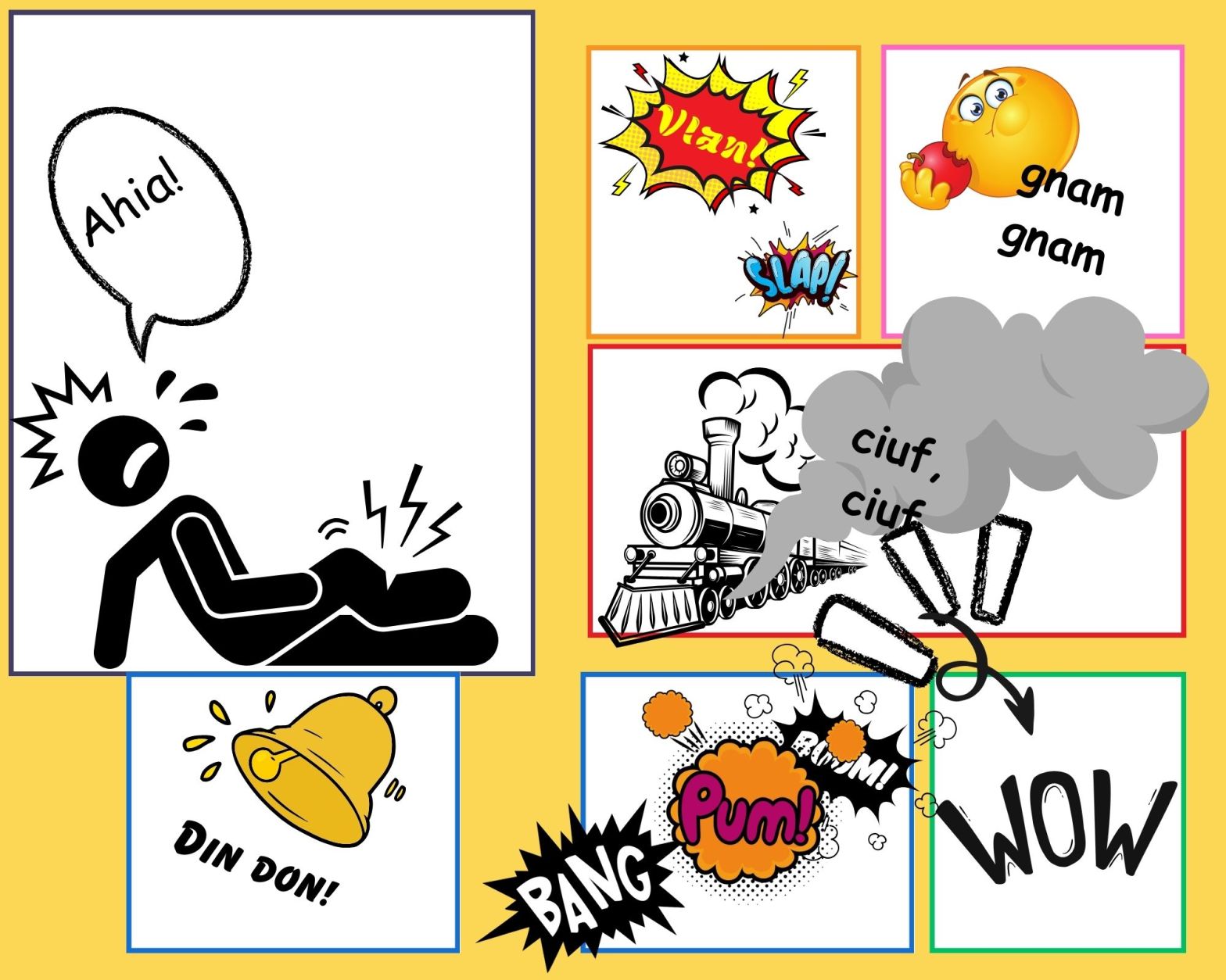
Crack! Brrr! Mmmm! These sounds, representing actions, are onomatopoeic. In one blog I found this statement about onomatopoeic words: “…there is another way to make us understood without using meaningful words: onomatopoeias…” but I would argue that onomatopoeic words are very much meaningful as they are a helpful way of showing, not telling, in our stories and adding zest, bringing them to life for either our listeners or our readers! According to Merriam-Webster’s online dictionary, onomatopoeia is exactly that: “the naming of a thing or action by vocal imitation of the sound associated with it (such as buzz, hiss).” Thus, Italian toddlers first learn to name animals by the sounds they make: a dog is a bau bau, a duck is a qua qua. According to Merriam-Webster, verbs that we now take for granted as actions in English were once actually onomatopoeia: snap, crackle, pop, jingle, sizzle, toot, blimp, tinker, cuckoo, coo, gobble, honk, hoot. If you or your students read comic books or graphic novels (or, if like me, you’re old enough to remember re-runs – or the actual first run – of the campy 1966 Batman TV series with Adam West in the title role!), then you are well familiar with reading onomatopoeic words!
In Italian, many onomatopoeic words are the adopted English version, like wow!, bang!, clang! (clang!), gulp!, aaargh!, sob, brr, bzzz, or French, like vlan (the sound of a face slap).Others are essentially their English counterparts written with Italian phonetics: bum! (boom!), crac! (crack!), gluglu (glug), bla bla (blah blah), bip (beep), din don or din don dan (ding dong), cucù (cuckoo). But there are a few purely Italian onomatopoeic words, as well as some purely entirely Italian ways to use others.
Cuccù (Cuckoo)
In the second meaning for this word, Treccani’s online dictionary says that cuccù is used to call out to people, like we do in English when we go into someone’s yard, garage, house or room and call out “Hey there!” or “Anyone home?,” as well as to let people know we are not getting involved in something or allowing ourselves to be taken for a ride. The Treccani entry also says that it is what children call out when playing hide and seek; thus, fare a cuccù means giocare a nascondino (to play hide and seek). Cuccù is also used when playing the “where am I?” game with babies, the game in which we cover our eyes with our hands and say “Oh! Where is so-and-so?” and then uncover our eyes saying “Here I am!” In Italian, it is “cuccù! Eccomi!” or “Ecco [baby’s name]!” or “Eccolo là!“
Gnam gnam (Mm-mm, Nom, Nom-Nom)
To represent eating sounds, or to represent “yummy” or “delicious,” Italians say gnam gnam. English speakers might say “mmm” – as in the old Campbell’s soup commercial “Mm! Mm! good!” – or “nom” or “nom-nom”.
Patatràc, Patacrash, Patapum, Pum! (Crash! Thud! Thwack! Boom!)
Patatràc nowadays is used to indicate a disaster: È successo un patatrac sull’autostrada. (There’s been a disaster on the highway.) However, it was also used to represent the sound made by a person falling for example out of a broken chair and onto the floor, or of an object falling off a high shelf onto the floor. In English we would use either “crash” or “thud.” Patacrash is the sound made by many objects falling or thudding all at once to the ground. Patapum on the other hand is reserved for a person falling, or crashing, to the ground. Pum is the original Italian version of “boom” but is also used for thud. In my family, pum and pummalalà were used when babies or toddlers in our family who were learning to walk suddenly fell down onto their bums; it was usually said as an interjection with a broad smile, to help the babies or toddlers with their surprise and to deflect any potential wails.
More for newsletter subscribers only!
Do you need a lesson plan that will get a lot of engagement but be an easy prep for you? Do you wonder what else you can do to keep students doing Italian, target language, but it’s one of those loose or extra school days (like the half days or Early Release) or something to keep them going during or in between school-wide tests (just in case you get observed) or just for what I call a soft re-entry after a school vacation? If you teach FLES at the preschool or elementary level or if you teach 6th (or even 7th) grade – but I have learned that 8th graders definitely do not enjoy this (though some 9th graders have had fun in my classes with this) – then the subscriber-only post coming to your inbox on Monday morning is for you!
Please subscribe to this newsletter! It’s free! If you have already subscribed and have enjoyed the Project-Based Italian content, please tell your friends and colleagues and ask them to subscribe here too! Subscribers receive extra lesson or unit plans! Have you used the information in this or past posts in your classes or the unit or lesson plans offered by Project-Based Italian? Please comment below and share your experience!
 Project-Based Italian