Suggestions for how to teach about Women’s Day to American students in Grades 7-12, including a lesson plan and student project guide.
Do you celebrate Women’s Day? If so, how? Please share in the comments!
What Is La festa della donna?
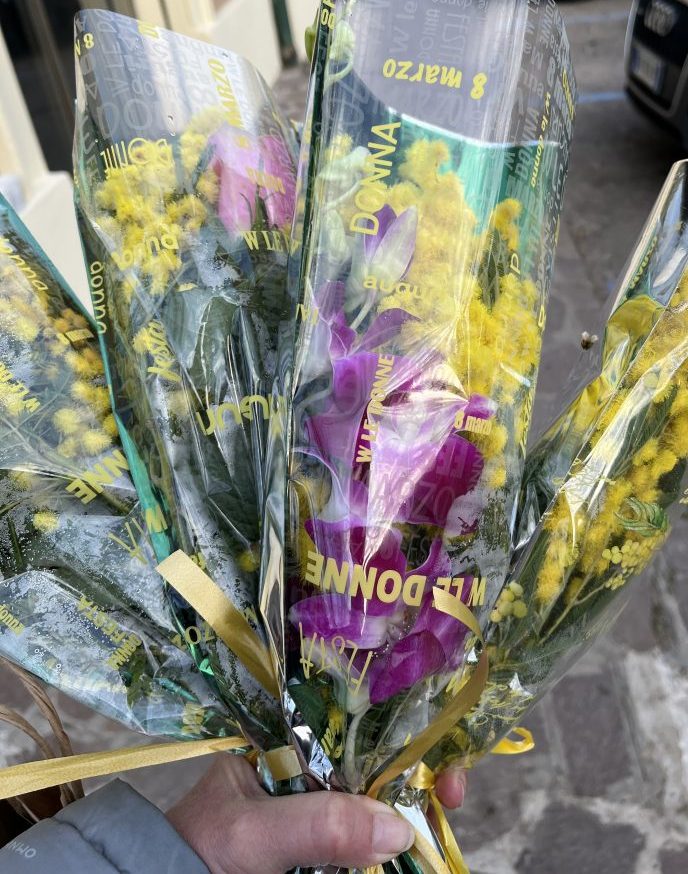
Every year on March 8th, a unique celebration unfolds across Italy. Streets, workplaces, and schools fill with the bright yellow blossoms of mimosa flowers as Italians mark La festa della donna – Women’s Day. While March 8th is recognized globally as International Women’s Day, Italy’s version of the holiday has its own rich identity, deep traditions, and ongoing cultural debates that make it a fascinating subject for students studying world cultures, languages, and social issues.
This article introduces U.S. middle and high school students to how Women’s Day is observed in Italy, why the mimosa flower holds such symbolic power, and how modern Italians are wrestling with questions about whether the holiday truly honors women or has drifted away from its feminist roots.
From Labor Rights to National Holiday
International Women’s Day has its origins in the labor movements of the early 20th century. In the United States, the first National Woman’s Day was observed on February 28, 1909, organized by the Socialist Party of America to honor striking garment workers in New York City. The movement spread to Europe, and by 1911, Women’s Day was being celebrated in Germany, Austria, Denmark, and Switzerland.
In 1917, Russian women went on strike demanding bread and peace, helping spark a revolution that led to women gaining the right to vote in Russia. The United Nations officially recognized March 8th as International Women’s Day in 1975.
In Italy, the holiday took on its own character after World War II. As Italy emerged from fascism and rebuilt its democracy, women’s groups – particularly left-wing feminist organizations – embraced March 8th as a day to advocate for women’s rights, including reproductive rights, equal pay, and access to education. In the 1940s and 1950s, Italian women’s unions (most notably the Unione Donne Italiane, or UDI) helped establish many of the traditions still associated with the holiday today.
The Mimosa Flower: Italy’s Symbol of Women’s Day
Ask any Italian what they associate with March 8th, and the answer is almost always immediate: the mimosa (the flower, not the drink). The bright yellow, pom-pom-like blossoms of the Acacia dealbata, commonly known as the mimosa tree, have become the unmistakable symbol of La festa della donna. But why the mimosa in particular?
The story goes back to post-war Rome in the late 1940s. Activist Teresa Noce and other leaders of the UDI were looking for a flower to represent the holiday. Roses and violets, popular choices in other countries, were expensive and not widely available in early March. The mimosa, however, bloomed naturally throughout central and southern Italy in late winter and early spring, making it accessible to women of all economic backgrounds. It was affordable, cheerful, and distinctly Italian.
Nowadays, in the days leading up to March 8th, street vendors across Italian cities sell bunches of mimosa branches. Men traditionally give them to the women in their lives – mothers, wives, daughters, colleagues, and friends – as a gesture of appreciation and respect. Schools often do craft projects with mimosa motifs, and pastry shops create special desserts called mimosa cakes (torta mimosa), a layered sponge cake topped with crumbled yellow sponge to resemble the flower’s fluffy clusters.
How La Festa della donna Is Celebrated Today
At Home and in the Community
Family celebrations are central to La festa della donna. It is common for men to cook dinner or take the women in the family out to a restaurant. Fathers give mimosas to their daughters; sons bring flowers to their mothers. The holiday has some similarities to Mother’s Day in the U.S., though it is meant to honor all women, not just mothers.
Many Italian cities organize public events: concerts, theater performances, art exhibitions, and political rallies focused on women’s issues. Community organizations and local governments often host free events for women, and museums may offer free or discounted admission.
At School
Italian elementary and middle schools frequently incorporate La festa della donna into classroom activities in early March. Students learn about famous Italian women throughout history, create art using mimosa imagery, and discuss the meaning of gender equality. Teachers may share stories of pioneering Italian women such as:
Rita Levi-Montalcini — Nobel Prize-winning neuroscientist
Grazia Deledda — First Italian woman to win the Nobel Prize in Literature
Nilde Iotti — First woman to serve as President of the Italian Chamber of Deputies
Samantha Cristoforetti — Italy’s first female astronaut
In the Workplace
In Italian workplaces, it is common for male colleagues to bring mimosa flowers for their female coworkers. Some companies organize small celebrations or events. In recent decades, however, there has been growing discussion about whether workplace observances truly address issues of gender equality or simply serve as a superficial gesture.
The Tradition of “Girls’ Night Out”
One of the most distinctive Italian traditions associated with March 8th is the custom of women going out together, without men, on the evening of the holiday. Groups of women, usually friends or coworkers, go to dinner, clubs, or shows. This “girls’ night out” tradition began in the 1970s and 1980s and reflects the spirit of female solidarity and independence. This evening-out tradition has few direct equivalents in American Women’s Day observances and often surprises U.S. students when they learn about it.
Controversies and Debates
While La Festa della donna is still widely celebrated, it is also the subject of significant debate in Italy. These controversies make it a rich topic for classroom discussion, especially at the middle and high school level.
Has the Holiday Lost Its Political Meaning?
Many Italian feminists and women’s rights advocates argue that La Festa della Donna has become too commercialized and has lost its original power as a day of political advocacy. Critics point out that giving flowers and taking women to dinner, while nice gestures, do nothing to address the serious challenges Italian women still face: one of the lowest female employment rates in the European Union, a significant gender pay gap, high rates of domestic violence, and underrepresentation in politics and corporate leadership. Some Italian feminist groups refuse to celebrate the holiday at all, arguing that a single day of appreciation papers over systemic inequality.
The Mimosa Industry and Environmental Concerns
Italy imports enormous quantities of mimosa flowers in early March, much of it from other countries, particularly from the Netherlands and Kenya. Environmental advocates have raised concerns about the carbon footprint of transporting large amounts of cut flowers internationally. Some Italians now advocate for planting mimosa trees locally or using sustainable alternatives.
Violence Against Women: A Dark Counterpoint
Perhaps the most serious controversy surrounding La festa della donna is the uncomfortable contrast between the holiday’s festive atmosphere and Italy’s ongoing crisis of femminicidio, the Italian term for the killing of women by men, especially intimate partners. According to data from Italy’s Interior Ministry, dozens of women are killed by partners or ex-partners in Italy every year. Advocacy groups use March 8th as an opportunity to draw attention to this violence, staging protests and demanding stronger legal protections.
Gender and the Gift-Giving Tradition
Some modern Italians question the tradition of men giving flowers to women, arguing that it reinforces a patronizing dynamic in which women are passive recipients rather than active agents of their own liberation. In recent years, more Italians have embraced a version of the holiday in which women celebrate themselves and each other, independent of male gestures. LGBTQ+ communities in Italy have also pushed for a more inclusive version of the holiday that honors all gender identities.
The Night Out Tradition and Stereotypes
The tradition of women going out to clubs or bars on the evening of March 8th has also attracted criticism. Some feminist commentators argue that equating women’s liberation with a night out drinking or dancing reduces the holiday’s meaning. Others defend the tradition as a genuine expression of female bonding and autonomy. This debate often reflects broader cultural tensions about how feminism should look and who gets to define it.
Comparing Italian and American Observances of Women’s Day
For American students, comparing La Festa della Donna to how International Women’s Day is observed in the United States can be illuminating. In the U.S., International Women’s Day has historically been less prominent than in many other countries, though observance has grown significantly since the mid-2010s.
| Italy (La Festa della donna) | United States (International Women’s Day) |
| Widely observed as a near-national holiday | Growing in awareness but not a federal holiday |
| Mimosa flowers are the iconic symbol | No single dominant flower symbol |
| Strong tradition of women going out together in the evening | No equivalent widespread social tradition |
| Rooted in post-WWII feminist and left-wing political movements | Rooted in early 20th century labor movements |
| Significant commercial aspect (flowers, gifts, restaurants) | Commercial presence is growing but less dominant |
| Feminist critics argue the holiday is too commercialized | Debates about inclusion, intersectionality, and corporate co-optation |
| Femminicidio crisis gives the day a somber undertone for many | Domestic violence awareness is an associated issue |
Sample 3 Day Lesson Plan
The following three-day lesson plan is designed for grades 7–12 Italian, but you should definitely share it with colleagues in Social Studies and/or ELA courses. Use this article as the primary reading text or source and end with a student-centered project.
If you use this lesson plan, or any part of it, please comment and share your experience with your students – and any tweaks you recommend!
Objectives
Students will be able to:
1. Describe the history and cultural significance of La Festa della Donna in Italy.
2. Identify key traditions, symbols, and controversies surrounding the holiday.
3. Compare Italian Women’s Day traditions to Women’s Day observances in the U.S.
4. Demonstrate understanding through a creative culminating project.
Materials Needed
Printed article or digital access to this post; colored markers/art supplies or devices; poster boards or slideshow software; access to library/internet for research.
Day 1 (Introduction – 50 minutes)
Brainstorming/schema building (10 minutes): Show students a photo of mimosa flowers and ask: “What do you think this flower might represent? Could a flower be controversial?” Allow brief discussion.
Direct Instruction (20 minutes): Read and discuss sections 1–3 of the article (History, Traditions, Mimosa flower). Use a KWL chart on the board.
Guided Discussion (15 minutes): Compare International Women’s Day in the U.S. vs. Italy. What is the same? What is different?
Exit ticket (5 minutes): Write one thing you learned and one question you still have.
Day 2 (45-50 minutes)
Review (5 minutes): Share exit ticket responses from Day 1.
Read & Discuss (20 minutes): Read sections 4–5 on Controversies and Modern Celebrations. Use a T-Chart: “Arguments FOR current traditions” vs. “Arguments FOR change.”
Project Launch (20 – 25 minutes): Introduce the Mini-Project. Form groups, assign roles, begin brainstorming and research.
Possible Homework: gather research for your group role.
Day 3 (45-50 minutes)
Work Time (25 minutes): Groups finalize and assemble their Cultural Showcase projects.
Gallery Walk / Presentations (20 minutes): Groups present or display their projects.
Class debrief or Exit Ticket (5 minutes): “What surprised you most? What would you want to keep or change about these traditions if you were Italian?”
Project and Cultural Showcase
Project Overview
In groups of 3–4, students will create a Cultural Showcase comparing how Women’s Day is celebrated in Italy with how it is observed (or not observed) in their own community or another country of their choosing. The showcase can take one of the following formats:
A poster or trifold display board
A digital slideshow (Google Slides, PowerPoint, or Canva)
A short illustrated booklet (4–6 pages)
A short video (2–3 minutes)
Required Elements
A title and introduction explaining what this holiday is.
At least THREE specific traditions from Italy’s Women’s Day (e.g., mimosa, the night out, the torta mimosa).
At least ONE controversy or debate surrounding the holiday.
A comparison section showing at least TWO similarities or differences between Italy and the U.S. (or another chosen country).
A personal reflection: “If you could redesign Women’s Day for your community, what would it look like?”
A bibliography or source list (at least 2 sources beyond this article).
Suggested Group Roles
Researcher: Finds additional sources and facts about La Festa della Donna.
Writer/Editor: Drafts the text sections of the project.
Designer/Artist: Creates the visual layout, graphics, or illustrations.
Presenter: Leads the group presentation or narrates the video.
Note: In smaller groups, roles may overlap. All members should contribute to research and review.
Student-Friendly Rubric: Cultural Showcase Project
Ask your students to self-assess their work using this rubric (which you will then also use to grade the project).
Directions to student(s): Use this rubric to check your work BEFORE turning it in. I will also use it to score your project. Total possible points: 16.
| Category | ⭐⭐⭐⭐ Excellent (4) | ⭐⭐⭐ Good (3) | ⭐⭐ Developing (2) | ⭐ Needs Work (1) |
| Research & Content | Uses 3+ sources; all facts about La Festa della Donna are accurate and detailed. | Uses 2 sources; most facts accurate with minor errors. | Uses 1 source; some inaccuracies or missing info. | Little to no research evident; many errors. |
| Creativity & Presentation | Project is visually engaging, original, and clearly communicates the topic. | Project is mostly clear; some creative effort shown. | Project is basic but understandable. | Project is incomplete or very difficult to follow. |
| Cultural Connections | Makes thoughtful comparisons between Italian and American Women’s Day traditions. | Makes some comparison with limited depth. | Mentions both cultures briefly without meaningful comparison. | No cultural comparison made. |
| Collaboration & Effort | All group members contributed equally; work reflects strong effort. | Most members contributed; effort is mostly evident. | Uneven participation; minimal effort from some members. | Little evidence of collaboration or effort. |
Scoring to Grade Conversion: 14–16 pts = A | 11–13 pts = B | 8–10 pts = C | 5–7 pts = D | Below 5 = Needs significant revision
Discussion & Extension Questions
You can extend this into a week or two week cultural unit, if you have room in your curriculum or pacing structure, by adding these questions for Socratic seminar, journal writing, or small-group discussion:
Why do you think Italy chose the mimosa flower to represent Women’s Day? What object or symbol might you choose to represent the holiday in the United States, and why?
Some Italian feminist groups argue that La Festa della Donna has become too commercial and no longer serves its original purpose. Do you agree or disagree? Can you think of other holidays that have faced similar criticism?
The Italian tradition of women going out together on March 8th is not common in the U.S. What does this tradition say about female solidarity? Is there value in women-only spaces?
Italy has a serious problem with femminicidio. How does knowing this change — or not change — how you think about La Festa della Donna?
International Women’s Day is a national holiday in many countries but not in the United States. Should it be? Why or why not?
Research one famous Italian woman not mentioned in this article. What did she contribute, and why should students know about her?
Key Vocabulary
The following terms are important for understanding this topic:
| Term | Definition |
| La Festa della Donna | Italian for “Women’s Day”; celebrated on March 8th each year in Italy. |
| Mimosa | A flowering tree (Acacia dealbata) whose yellow blossoms are the symbol of Women’s Day in Italy. |
| Torta Mimosa | A traditional Italian sponge cake made to look like mimosa flowers; served on Women’s Day. |
| Femminicidio | The Italian term for the killing of women, especially by intimate partners; a major social issue in Italy. |
| UDI (Unione Donne Italiane) | The Italian Women’s Union; a feminist organization founded in 1945 that helped establish Women’s Day traditions in Italy. |
| International Women’s Day | A global holiday on March 8th honoring women’s social, economic, cultural, and political achievements. |
| Solidarity | Unity and cooperation among people with a common interest or goal; a key theme of Women’s Day. |
| Gender Pay Gap | The difference in average earnings between men and women doing similar work; a major issue in Italy and the U.S. |
Please comment and share your experience (past, present, and future)! Did you already have a unit or lesson(s) created for Women’s Day in Italy? Did this lesson give you any fresh ideas or did you decide to include this holiday in your curriculum because of this post? Share what you already do around this cultural topic or what you would like to add around this topic!
 Project-Based Italian