I began my career in Melrose in 2013-2014. In that year I also began my exploration of Project Based Learning by creating a quarter-long unit on the Commedia dell’Arte Italian literary period (examples of this are works by Goldoni, the Italian playwright, the creation of stock characters still in use today such as Harlequin, Colombina). I always taught this in the last quarter of the year because, quite frankly, Theater/Arts/Music was the last chapter in the textbook.
I ditched the textbook for everything except vocabulary and created my own unit, beginning with the essential question of what makes us laugh (which is actually an adaptation of the central philosophical question in The Name of the Rose by Umberto Eco: did Jesus laugh?)? This unit was an exploration of the idea many people have that jokes cannot be translated from one language to another as well as an exploration of theater, body language, verbal language and the Italian roots of stock comic (and tragic) characters.
The unit began by showing clips of TV programs or stand up comics – the first five chosen by me and the rest chosen by students to share with all of us. Although it was an Italian language class, we began exploring the question and the topic in English and gradually moved to production into Italian. The World Language Department has a requirement of four open responses (written summative assessments) and four core assignments (speaking/oral summative assessments) so the end product for this unit was a group project in which students showed their learning by updating the stock characters and producing improvised oral skits.
As it turns out, this is really more of an example of UDL (Universal Design for Learning) and not quite PBL (project based learning) but it does go to show that you can start your journey at any point – even with an imperfect understanding of the learning technique or philosophy!
My refined (but still imperfect) understanding and implementation of PBL
This Google Site holds a truer PBL project with an actual real-world problem (dying Italian towns) for Italian 4 Honors students (juniors and seniors) to explore and solve.
Project Based Learning (PBL) is all about exploring and offering possible solutions for an authentic, real-world issue or problem. But it does not end there! The last component of a PBL project is to share it with a community audience. In his post on the Summit Learning Blog (September 6, 2018), John Larmer says: “[…] two things are essential to achieve the best project based learning experience for students. The first essential element is to make student work public to a community outside of the classroom. The second is to make the project fully authentic, as opposed to a simulation or simply an “engaging task.””
While my original Commedia dell’arte unit and project, which I created in 2013 and continued to use and fine-tune until 2016, was an exploration of a real-world issue (jokes/humor and translation from culture to culture and language to language), it was heavily guided by me (though I included lots of Voice & Choice, a UDL element). It did not include student-driven research or a problem-solving element (because ultimately I guided them to my own understanding that there are some universals across cultures, even in comedy) and the end product was not shared with a community beyond the students’ own classroom (though sometimes we did share with another cohort of students engaged in the same project). My Commedia dell’arte unit was a step towards PBL, and a bigger step towards UDL, but it was what PBLWorks.org calls a “dessert project” – while a true PBL unit/project is “the main course.”
My most recent attempt at PBL is “The Depopulation Crisis in Italy” project. The project arose from a casual conversation I had in September 2020 with a high school junior (who came to visit me remotely in the first FLEX Google Meet, so that I would not be alone), in which we discussed whether people really need to attend college to be successful in adult life, and revealed his interest in real estate as a career option. The project solidified as I kept seeing headlines and reading articles in English-language as well as Italian-language news outlets about the one Euro houses being sold in Italy and Spain, in particular. The framework generously supplied by my district’s Assistant Superintendent for Technology and our Academic Facilitator is: Connect, Speculate, Investigate, Frame, Express, Reflect.
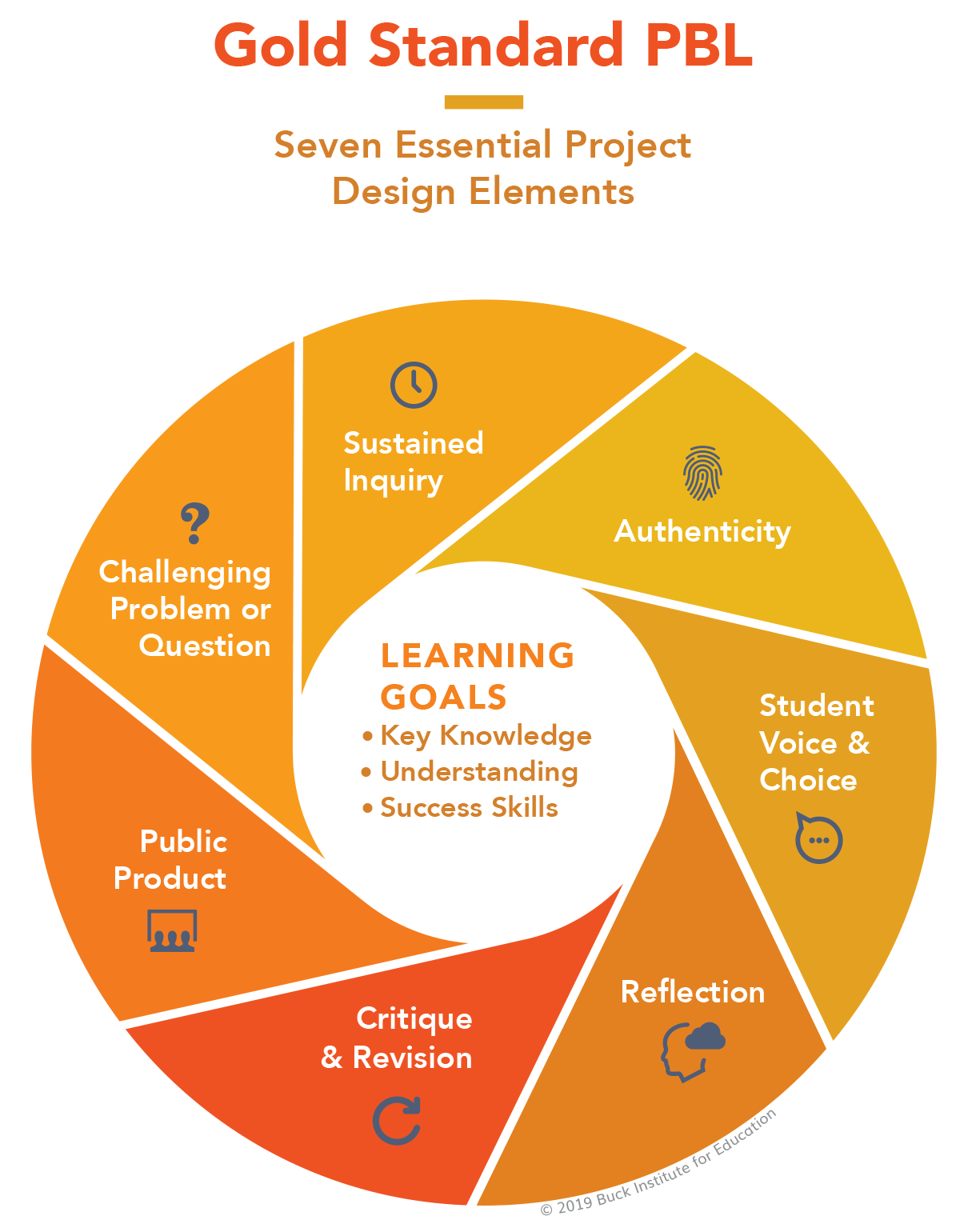
What makes this project PBL? For any project to be part of the “main course,” that is, a project-based learning unit, it needs to include seven elements in its design:
Element 1 Challenging Problem/Question: The Depopulation project incorporates an authentic, real-world issue or challenge in Italy (the “dying” town phenomenon and also the sustained low birth rates in Italy, which has Italian demographers positing a potential “death” of Italy as a nation). The driving question asks “How can we save a “dying” town or nation?” and is on the Home, Connect and Speculate pages on the project’s Google Site.
Element 2 Sustained Inquiry: The Speculate page asks students to brainstorm questions or ideas (that they then put into question form) on a shared QFT document. It is sustained inquiry because students can engage in this process across multiple class meetings (this unit was scheduled for six 90 minute blocks during remote teaching/learning, but could be stretched over an entire month, quarter, or longer as well).
Element 3 Authenticity: This project focuses on an issue currently affecting many towns in Italy and Spain and other parts of Europe as well as the country of Italy (encompassing current societal issues of sustained low birthrates, breakdown of the nuclear family, economic migration issues, etc.). This meets Larmer’s “second essential element.”
Element 4 Student Voice & Choice: In the Frame tab, this project asks students to review, discuss their research collaboratively and to decide what product(s) to create and produce in order to share their findings and proposed solutions. Students are encouraged to add a new driving question or focus, as well, based on how their research shapes their thinking.
Element 5 Reflection: This project currently initially lacked a Reflection piece but now has a 3-2-1 Google Doc in which students are asked to share, in English, 3 takeaways from their learning, 2 they would have liked to explore further, and 1 thing they enjoyed in this work. I am still trying to frame how best to elicit student reflection that will allow students to choose the aspect(s) of the project to reflect on and share, though. If you have any ideas for improvement, please, please, please share in the comments below!
(Missing) Element 6 Critique & Revision: This project currently lacks a piece in which they peer review, give and receive feedback (other than mine) so that they can refine their research and improve both their process and their final product(s). There is also currently no tab on the Google Site for this element.
(Missing) Element 7 Public Product: To meet this element, (students need to share their product(s) with an audience beyond the classroom. In this project students are asked to upload their final product(s) to the site’s Express tab. To meet Larmer’s “first essential element” I would perhaps invite the Consul General (or other official) from the Italian Consulate to attend a Google Meet presentation of student work. Do you have any other ideas about how students could share this publicly? Please comment below!
As you can see from the two missing elements, the Depopulation Crisis in Italy project almost meets PBLWorks.org’s Gold Standard design. But that has not deterred me from piloting and refining this new project with my Italian 4 Honors students (high school juniors and seniors); they are giving me great feedback (many enjoyed this project most as we got into the Investigate stage) for revising its design and implementation for next year!
If you decide to try this project in your classroom, or a different one, even if yours may be missing elements, please share your experience in the comments!
 Project-Based Italian
You asked if there were any suggestions for a different audience besides having an Italian rep from consulate or embassy – what about finding a class in Italy to present to? I do video exchanges with schools in Italy (novice level) and it has been interesting from my students to hear from Italian students. You could ask for their comments on your students’ presentation.
Also – a suggestion for another topic could be the Sustainable Development Goals. I see the Cocciara Institute is offering PD on this (in NJ) and a teacher who I work with in Milan mentioned it this year, although I have not read enough to think about how to use them kn middle school. But I am curious.
LikeLiked by 1 person
Thank you so much for this thoughtful comment and excellent suggestion! I was on sabbatical in Italy and established a relationship with both teachers and students at a high school in Torino, and we are definitely talking about trying to connect our classrooms. I was worried about the time zone difference, but a video exchange would solve that problem! Are there sites that facilitate finding classes, schools, teachers in Italy with whom to collaborate? Is there one that you recommend?
The Sustainable Development Goals is actually something I am exploring using for another unit. I went to the MaFLA Proficiency Academy again this year and Leslie Grahn mentioned teachers have started using these. I think they can definitely be integrated into existing curriculum, from what I have seen on the site, but, like you, I have not read enough yet.
Thanks again so much for commenting, in spite of the site issues! Let’s keep this conversation going!
LikeLike
Regarding exchanges with Italian schools, I have always found partner schools using http://www.epals.com. I liaised with a school in Valtellina (north of Milan) for about 8 years, and now a teacher in Milan for 4 years and a teaching in Bari for 2 years. I have met three of the teachers (there was another from San Benedetto del Tronto, but she moved to high school) in real life during trips to Italy. In the past we matched students for penpal letters, but more recently the teachers have wanted to use Flipgrid, and with the Milan school we did a “Mystery Skype” in live time where students had to ask questions to the other school and deduce where the students were from their answers. The other students stayed after their school time to do it live. It wasn’t perfect but it was a great lesson in communicating with foreign students, as there were accents to contend with and since there was no trial run at times there was a little confusion, but overall it did go well and the students were able to guess the locations from the cues. And the reflections on the activity were good. I was curious about your sabbatical. I have just returned from 2 weeks at a language school in Rome through an ACTFL scholarship. I am also the person who knew Nanni Moretti movies from Twitter. In fact in my advanced language class we saw clips from Habemus Papem and discussed reviews. Although I teach middle school in Waltham I was going to let one of the high school teachers know about your blog, since one teacher is switching to teach higher levels this year and she might find your activities interesting. I also teach a short unit on carnevale masks and have created some resources about some of the commedia dell’arte characters, although I haven’t always been able to use them! My students have made glitter masks that I learned from a MITA workshop way back in 2008 or 2009. Anyway I appreciate the blog and the insights of another local Italian teacher!
LikeLike
I tried to comment but after writing my comment and pushing send it told me it was a duplicate comment!
Also every time I try to read a new post the site acts like I have not subscribed.
Anyway, here are the screen shots of my response.
<
div dir=”ltr”>
<
blockquote type=”cite”>
LikeLike
Thank you so much for letting me know! I will try to troubleshoot this today!
LikeLike